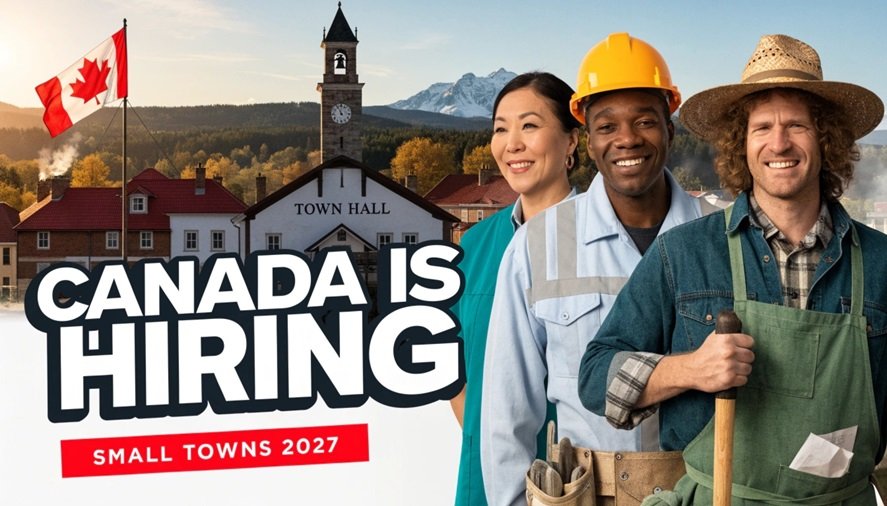
Are you looking for a way to work and eventually settle permanently in Canada? You may want to look beyond major cities such as Toronto, Vancouver, Calgary and Montreal.
Canada is expanding its focus on smaller communities that need skilled workers to support local businesses, healthcare services and economic development.
The big news for 2027 is that Canada is making its Rural Community Immigration Pilot a permanent immigration program. This creates an important opportunity for eligible foreign workers, including applicants from Ghana, Nigeria, Kenya, Uganda, South Africa and other African countries, to pursue employment and permanent residence in participating rural communities.
The programme is particularly interesting because it connects eligible employment opportunities with a community recommendation and a pathway to Canadian permanent residence.
In this guide, OWAFK Africa explains how the programme works, which communities are expected to participate, the types of jobs to investigate, eligibility requirements and where to find official information.
Canada Introduces a Permanent Rural Immigration Programme for 2027
On November 9, 2026, Immigration, Refugees and Citizenship Canada (IRCC) announced that the Rural Community Immigration Pilot would become a permanent programme known as the Rural Community Immigration Program (RCIP).
The programme is designed to help smaller and rural communities attract skilled foreign workers for jobs that local employers struggle to fill.
Unlike a general job-search programme, the RCIP is employer- and community-led. Participating communities identify their labour needs, establish priority occupations and designate employers that are eligible to recruit foreign workers through the programme.
The government has also announced 5,500 admission spaces for the Rural Community Immigration Program under the 2027–2029 Immigration Levels Plan.
This is a permanent immigration pathway, but it does not mean that every employer in a small Canadian town can recruit foreign workers through it.
Only designated employers offering eligible jobs in participating communities can use this pathway.
14 Canadian Communities Expected to Participate in 2027
The Canadian government has indicated that the 14 communities participating in the Rural Community Immigration Pilot are expected to continue under the permanent programme.
These communities are located in different provinces and offer opportunities to explore outside Canada’s largest cities.
1. Pictou County, Nova Scotia
Pictou County is a rural community in Nova Scotia. It is one of the participating communities and has experience using rural immigration to help local employers recruit workers.
2. North Bay, Ontario
North Bay is located in northeastern Ontario. Foreign workers can investigate employment opportunities with eligible local employers in the community.
3. Sudbury, Ontario
Sudbury is another participating Ontario community. Applicants should research local employment opportunities and the occupations identified as priorities.
4. Timmins, Ontario
Timmins is located in northern Ontario. Its participation creates another location for skilled workers to investigate eligible employment opportunities.
5. Sault Ste. Marie, Ontario
Sault Ste. Marie is a participating community in Ontario. Applicants should check the local programme website for designated employers and available positions.
6. Thunder Bay, Ontario
Thunder Bay is located in northwestern Ontario. It is included among the communities expected to participate in the permanent rural programme.
7. Steinbach, Manitoba
Steinbach is a participating community in Manitoba. Foreign workers can investigate opportunities with local employers in eligible priority occupations.
8. Altona/Rhineland, Manitoba
Altona/Rhineland is another participating Manitoba community. Check its official programme information for employment opportunities and recruitment requirements.
9. Brandon, Manitoba
Brandon is included in the rural immigration initiative. Applicants should investigate the local labour market and designated employers before applying.
10. Moose Jaw, Saskatchewan
Moose Jaw is one of the participating Saskatchewan communities. Interested applicants should check the community’s official recruitment and immigration information.
11. Claresholm, Alberta
Claresholm is a smaller Alberta community participating in the programme. Applicants should look for employers and occupations approved under its local priorities.
12. West Kootenay, British Columbia
West Kootenay is a participating region in British Columbia. Its local programme information can help applicants identify eligible employers and employment opportunities.
13. North Okanagan Shuswap, British Columbia
North Okanagan Shuswap is another participating British Columbia region. Interested workers should check its official website for current programme information.
14. Peace Liard, British Columbia
Peace Liard is included among the 14 participating communities. Applicants should investigate local employer requirements and priority occupations.
Important: These are communities expected to continue from the pilot into the permanent programme. Their inclusion does not mean every community has an open vacancy for overseas applicants. Check each community’s official website for updated designated-employer lists, priority occupations and recruitment information.
What Types of Jobs Can Foreign Workers Find?
The programme is designed to respond to labour shortages identified by participating communities.
The types of jobs available will depend on the needs of each community and the employers it designates.
Some sectors worth investigating include:
1. Healthcare and social services
2. Construction and skilled trades
3. Education
4. Manufacturing and production
5. Sales and services
6. Other priority occupations
Some communities may identify additional occupations based on their local economic needs. The actual list can differ from one community to another.
Do not assume that every occupation listed above qualifies. You must check the current priority occupation list and the employer’s designated status in the community where you want to work.
How Does the Rural Community Immigration Program Lead to Permanent Residence?
One of the most important features of the programme is that it provides an economic immigration pathway to Canadian permanent residence.
The process generally involves the following stages.
Step 1: Find a designated employer
You must identify an employer approved by the participating community to recruit workers through the programme.
A normal job offer from an employer that is not designated will not automatically qualify.
Step 2: Secure an eligible job offer
You must receive a genuine job offer that meets the programme’s requirements.
The position must fall within the community’s eligible priority sectors or occupations and satisfy the applicable employment and wage conditions.
Step 3: Apply for a community recommendation
After receiving an eligible job offer, the employer and applicant follow the community’s recommendation process.
The community assesses whether the employment offer is genuine and whether the applicant meets its programme requirements.
If approved, the community issues a recommendation certificate.
Step 4: Apply for permanent residence
Once you have the required recommendation certificate and meet the other eligibility conditions, you can submit an application for Canadian permanent residence to IRCC.
The federal government will assess your application, including admissibility and the required supporting documents.
Step 5: Complete the immigration process
If your application is approved, you can receive permanent resident status and settle in the participating community, subject to the programme’s requirements.
The programme is intended to support long-term settlement, not simply short-term employment.
Who Can Apply from Ghana and Other African Countries?
The programme is not limited to people already living in Canada. Eligible applicants may apply from outside Canada, including from African countries.
However, you must satisfy the applicable requirements.
The main requirements include:
1. A valid job offer
You must have an eligible job offer from a designated employer in a participating community.
2. Relevant work experience
Applicants must meet the programme’s work experience requirements unless they qualify for an applicable exemption.
Under the previous pilot, the standard requirement was at least one year of related work experience, equivalent to 1,560 hours, within the previous three years. Check the permanent programme’s final instructions for the requirements that apply to your application.
3. Educational qualifications
You must have a Canadian educational credential or an accepted foreign equivalent.
Applicants with foreign qualifications may need an Educational Credential Assessment (ECA) to demonstrate that their education meets the Canadian requirement.
4. English or French language ability
You must demonstrate your language ability through an approved language test.
Depending on the job’s classification and the applicable programme requirements, the required language level may differ.
English-speaking applicants from Ghana, Nigeria, Kenya, Uganda and other African countries should not assume that their education in English automatically removes the language-test requirement.
5. Settlement funds
You may need to demonstrate that you have sufficient funds to support yourself and your family when moving to Canada.
The applicable amount depends on your family size and the programme’s rules. Some applicants who are already authorised to work in Canada may qualify for an exemption.
6. Intention to live in the participating community
You must genuinely intend to live and work in the community that recommends you.
This is not a pathway for obtaining a recommendation from a small town while planning to settle permanently in Toronto or Vancouver.
Can You Move to Canada with Your Family?
The programme provides a permanent residence pathway for eligible skilled workers and their accompanying eligible family members.
Your spouse or common-law partner and dependent children may be included in your permanent residence application, subject to Canadian immigration requirements.
Family members must meet the relevant admissibility and documentation requirements.
If you are planning to relocate with your family, research the cost of housing, healthcare access, schools, childcare and other settlement expenses in the community before accepting a job offer.
Can You Get a Work Permit While Waiting for Permanent Residence?
The previous Rural Community Immigration Pilot included an option for certain eligible applicants to obtain a temporary work permit while their permanent residence application was being processed.
The permanent programme’s transition arrangements and work-permit instructions should be checked directly with IRCC.
Do not assume that receiving a job offer or community recommendation automatically gives you permission to travel to Canada and start working.
You must obtain the appropriate authorisation before beginning employment.
Official information:
https://www.canada.ca/en/immigration-refugees-citizenship.html
How to Find Jobs with Designated Employers in Canada
If you are interested in applying, follow these steps.
Do not send applications randomly to every business in a participating town. Focus on employers that have been officially designated for the programme.
Important: The Previous Pilot Is Closing, but the Permanent Programme Is Taking Over
There is an important transition that applicants need to understand.
The Rural Community Immigration Pilot is scheduled to close on January 1, 2027, as the permanent Rural Community Immigration Program takes over.
Applicants who already have a valid recommendation under the pilot must follow the transitional rules and submit their applications before the recommendation expires.
The permanent programme is expected to begin issuing recommendations from January 1, 2027.
Therefore, anyone planning to apply in 2027 should follow the new programme’s official instructions rather than relying entirely on older pilot application guides.
Important Warning for African Job Seekers
Be careful when dealing with agents or individuals who promise guaranteed Canadian jobs or permanent residence through small-town immigration programmes.
Remember:
Always verify job opportunities through official employer and community websites.
Final Thoughts: Is Canada’s Rural Immigration Programme Worth Exploring in 2027?
Canada’s decision to make the Rural Community Immigration Pilot permanent is an important development for skilled foreign workers who want to build a future outside the country’s biggest cities.
For eligible applicants from Ghana, Nigeria, Kenya, Uganda, South Africa and other African countries, the programme offers an opportunity to pursue employment with designated employers in participating communities and potentially obtain permanent residence.
The most important step is to identify a genuine job opportunity with an employer approved under the programme.
Do not apply simply because a job is advertised in a small Canadian town. Confirm that the employer, occupation and employment offer meet the programme’s requirements.
Are you interested in working and settling in a small Canadian community in 2027? Tell us your profession and country in the comments.
Follow OWAFK Africa for more verified international job opportunities, visa information, scholarships, permanent residence pathways and relocation guides.
Visit: https://owafk-africa.com/
IMPORTANT OFFICIAL LINKS
Use these government resources to verify the programme and its requirements.
1. Canada’s announcement making rural immigration permanent
https://www.canada.ca/en/immigration-refugees-citizenship/news/2026/11/canada-creates-a-permanent-immigration-pathway-to-help-rural-communities-attract-and-retain-talent0.html
2. Overview of the new Rural Community Immigration Program
https://www.canada.ca/en/immigration-refugees-citizenship/news/2026/11/overview-of-the-rural-community-immigration-program.html
3. Canada Rural Community Immigration Pilot – previous programme information and participating communities
https://www.canada.ca/en/immigration-refugees-citizenship/services/immigrate-canada/rural-franco-pilots/rural-immigration.html
4. Previous pilot job offer and participating community information
https://www.canada.ca/en/immigration-refugees-citizenship/services/immigrate-canada/rural-franco-pilots/rural-immigration/job-offer.html
5. Previous pilot eligibility requirements
https://www.canada.ca/en/immigration-refugees-citizenship/services/immigrate-canada/rural-franco-pilots/rural-immigration/eligibility.html
6. Permanent programme regulations – Canada Gazette
https://gazette.gc.ca/rp-pr/p2/2026/2026-11-04/html/sor-dors217-eng.html
7. Official Canadian immigration website
https://www.canada.ca/en/immigration-refugees-citizenship.html