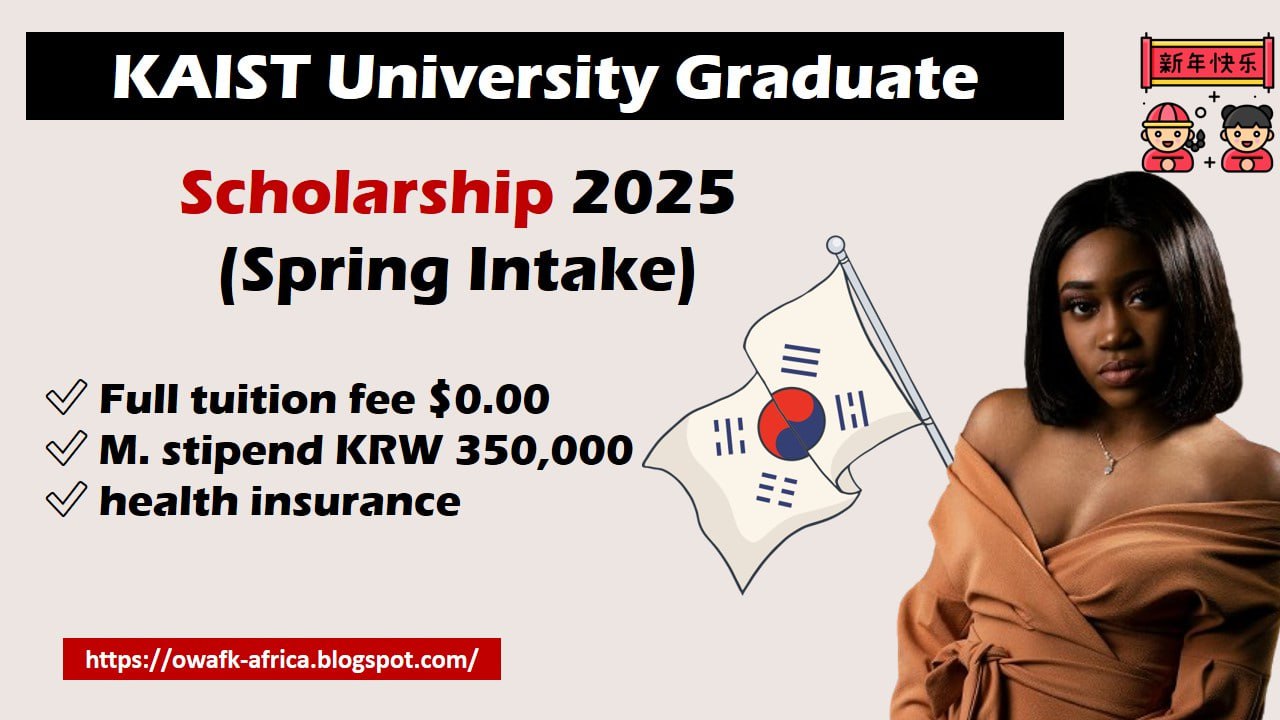
If you are looking for a fully funded Master’s or PhD scholarship in South Korea, the KAIST Graduate Scholarship 2027 is an opportunity worth considering.
The Korea Advanced Institute of Science and Technology (KAIST) offers financial support to international graduate students through its KAIST Scholarship and other competitive scholarship programmes. Depending on the scholarship and programme, students can receive full tuition coverage, a monthly stipend and National Health Insurance support.
For the Spring 2027 international graduate intake, KAIST has published application schedules, but applicants should be careful about deadlines because the university has different admission rounds and programmes. One official KAIST announcement lists an international graduate application period of August 18–September 1, 2026, while another Spring 2027 admission schedule lists a later application window of September 29–October 8, 2026 for a particular admission round.
Therefore, check the official KAIST admission page for the specific programme and admission track before submitting your application.
🎓 KAIST Graduate Scholarship 2027 — Quick Facts
Category | Details |
University | Korea Advanced Institute of Science and Technology (KAIST) |
Host Country | South Korea |
Study Level | Master’s, Master’s-PhD Integrated, PhD |
Students | International students |
Tuition | Full tuition support under KAIST Scholarship |
Living support | Monthly stipend |
Health insurance | National Health Insurance premium support |
Application | Online |
2027 Intake | Spring 2027 |
Deadline | Depends on admission round/programme |
🇰🇷 What Is the KAIST Graduate Scholarship?
KAIST is one of South Korea’s leading universities specialising in science, technology, engineering and related fields.
For international graduate students, KAIST provides several scholarship opportunities.
The main KAIST Scholarship provides:
For the standard KAIST Scholarship, the current published funding structure covers:
The exact monthly stipend can vary depending on factors such as the department, academic adviser, programme and research involvement.
This means you should not assume that every KAIST graduate student receives the same monthly amount.
💰 KAIST Scholarship Benefits
1. Full Tuition Coverage
The KAIST Scholarship provides a full tuition grant for the relevant period of study.
According to KAIST’s published international graduate funding information:
2. Monthly Stipend
Scholarship recipients receive a monthly stipend to help with living expenses.
However, the standard KAIST Scholarship does not have one universal stipend amount for every student.
The amount can depend on:
KAIST specifically advises applicants to contact the relevant department or programme for details about the stipend applicable to their intended programme.
3. National Health Insurance Support
The KAIST Scholarship also provides support for the premium associated with National Health Insurance.
⭐ Other KAIST Scholarship Opportunities
In addition to the standard KAIST Scholarship, international graduate applicants may be considered for other competitive funding opportunities.
KAIST Global Presidential Scholarship (KGPS)
The KGPS is available for eligible Master’s and Master’s-PhD Integrated applicants.
The published benefit includes:
Applicants who apply for the KAIST Scholarship in eligible programmes are automatically considered for KGPS; a separate KGPS application is not required. However, only highly competitive applicants are recommended for the scholarship.
KAIST Prestige Scholarship for International PhD Students
This scholarship is available to eligible Master’s-PhD Integrated and PhD applicants.
The published benefit includes:
Again, eligible KAIST Scholarship applicants are automatically considered, with outstanding candidates recommended through the university’s selection process.
KAIST CoE PhD Fellowship
For eligible College of Engineering programmes, the published fellowship provides:
Selection involves departmental and College of Engineering recommendation rather than a separate applicant-driven scholarship application.
🎓 What Can You Study at KAIST?
KAIST is particularly well known for science, technology and engineering.
Depending on the graduate programme, applicants can find opportunities in areas including:
Important: Available programmes and admission requirements vary by department, so applicants should check the specific programme before applying.
👩🎓 Who Can Apply?
The KAIST international graduate admission route is intended for qualified international applicants.
For Master’s admission, applicants generally need a Bachelor’s degree or an equivalent qualification.
For PhD admission, applicants generally need a Master’s degree or equivalent qualification.
Applicants who are still completing their degree may also be eligible if they can meet KAIST’s requirements for expected graduation before enrolment.
KAIST’s published graduate admission information should be used to determine your exact eligibility.
🌍 Can Africans Apply?
Yes.
International applicants from African countries can apply if they meet the relevant KAIST graduate admission requirements.
This makes the opportunity particularly relevant for students from countries such as:
and other eligible countries.
🗣️ English Language Requirements
Applicants should carefully check the current English-proficiency requirements for their admission track.
The source article lists the following benchmark scores:
Test | Score |
TOEFL iBT | 83 |
IELTS | 6.5 |
TOEIC | 720 |
TEPS | 326 |
However, do not treat these numbers as a universal requirement for every KAIST graduate programme without checking the current admission guide.
KAIST’s requirements can differ by admission track, and exemptions or waivers may apply in certain circumstances.
For example, KAIST’s published admission materials provide English-proficiency exemption provisions for applicants who meet specified nationality or previous-education conditions.
Always check the current programme-specific admission guide before deciding whether you need an English test.
📄 Required Documents
The exact document list depends on the programme and admission track.
Applicants should generally prepare documents such as:
Academic Documents
Personal Documents
Supporting Documents
KAIST states that application materials must be submitted according to its document guidelines and that applicants should prepare the required documents before the online application period.
✍️ Recommendation Letters
Recommendation letters are an important part of the graduate application.
Depending on the programme, you may need recommendations from:
Choose recommenders who can provide specific evidence of your academic ability, research potential, technical skills and suitability for graduate study.
Avoid choosing someone simply because they have an impressive job title.
📅 KAIST Spring 2027 Application Deadline
This is one area where applicants need to pay particular attention.
There is not necessarily one single deadline that applies to every KAIST graduate applicant.
KAIST’s published Spring 2027 information shows different admission rounds.
For example, one KAIST international graduate announcement lists:
Online application:
August 18, 2026 – September 1, 2026, 5:00 PM KST
Recommendation letter deadline:
September 8, 2026, 6:00 PM KST
Another official KAIST programme page lists a Spring 2027 application period of:
September 29, 2026, 10:00 AM – October 8, 2026, 5:30 PM KST, followed by interviews and final admission decisions.
⚠️ Important
The dates above demonstrate why applicants should not copy a single deadline from a scholarship blog and assume it applies to everyone.
Your deadline depends on the:
Before submitting your application, check the official KAIST International Graduate Admission schedule.
📝 How to Apply for KAIST Graduate Scholarship 2027
The application process is relatively straightforward.
Step 1 — Choose Your Graduate Programme
Start by identifying the Master’s, Master’s-PhD Integrated or PhD programme that matches your academic background.
Step 2 — Check the Department Requirements
Read the requirements carefully.
Pay particular attention to:
Step 3 — Prepare Your Documents
Scan and prepare your academic and supporting documents according to KAIST’s requirements.
Step 4 — Complete the Online Application
Submit your application through the official KAIST admissions system.
Step 5 — Pay the Application Fee
Make sure any required application fee is paid before the deadline.
Step 6 — Recommendation Letters
Ensure that your recommenders submit their letters before the recommendation deadline.
Step 7 — Selection and Interview
Depending on the programme, shortlisted applicants may proceed to an interview or other second-stage evaluation.
Step 8 — Final Admission Decision
Check the KAIST application system for the final result.
🔗 Official KAIST Application Portal
Applicants should use the official KAIST admissions system rather than third-party websites.
Apply through the KAIST Graduate Application System:
KAIST Graduate Application System
For international graduate admissions and current guidelines:
KAIST International Graduate Admission
💡 How to Improve Your KAIST Application
KAIST is a highly competitive university, so meeting the minimum requirements does not guarantee admission or a scholarship.
Here are some practical ways to strengthen your application.
1. Choose the Right Programme
Your academic background should make sense for the programme you’re applying to.
2. Highlight Research Experience
For research-focused graduate programmes, demonstrate:
3. Make Your CV Specific
Don’t simply list everything you’ve ever done.
Focus on accomplishments relevant to your intended programme.
4. Choose Strong Recommenders
Your recommendation letters should provide evidence of your ability rather than simply saying that you are “hardworking.”
5. Explain Your Goals Clearly
Your application should make it easy for the admissions committee to understand:
What have you done?
Why do you want this programme?
What do you want to research?
Why KAIST?
What do you plan to do after graduation?
❓Frequently Asked Questions
Is the KAIST Graduate Scholarship fully funded?
The KAIST Scholarship provides full tuition coverage, a monthly stipend and National Health Insurance premium support for eligible international graduate students.
How much is the KAIST monthly stipend?
There is no single standard amount for every KAIST Scholarship recipient. The stipend can depend on the department, programme, adviser and research involvement.
Some separate scholarships have specified amounts—for example, KGPS lists KRW 1,000,000 per month, while the KAIST CoE PhD Fellowship lists KRW 2,500,000 per month.
Can international students apply?
Yes. KAIST’s international graduate admission route is designed for international applicants.
Can I apply for a Master’s?
Yes, eligible international applicants can apply for Master’s programmes.
Can I apply for a PhD?
Yes. KAIST offers PhD and Master’s-PhD Integrated pathways for eligible applicants.
Do I need IELTS?
Not necessarily in every situation. Check the current requirements and any applicable exemption rules for your programme.
Can final-year Bachelor’s students apply?
Applicants who are completing their degree may be able to apply if they can satisfy KAIST’s expected-graduation requirements before enrolment. (futures.kaist.ac.kr)
Is KAIST only for engineering students?
No. KAIST offers graduate programmes across several areas, including science, engineering, life sciences, business and other technology-related disciplines.
🚨 Important Warning for Applicants
Be careful when you see articles claiming:
“KAIST Scholarship 2027 — everyone gets KRW X per month.”
That is not necessarily accurate.
KAIST’s standard scholarship information says the stipend varies according to factors including department, programme, academic adviser and research involvement.
Similarly, don’t assume that a deadline published on another scholarship website applies to your particular KAIST programme.
Always verify the deadline and funding conditions on the official KAIST website before submitting your application.
🌟 Final Thoughts
The KAIST Graduate Scholarship 2027 is an excellent opportunity for international students interested in pursuing advanced study in South Korea.
The strongest attraction is the combination of:
✅ Full tuition support
✅ Monthly financial support
✅ National Health Insurance support
✅ Master’s and PhD opportunities
✅ Study at a leading science and technology university
✅ International research environment
For students from Africa and other parts of the world, KAIST can be an especially attractive alternative to traditional scholarship destinations in Europe, North America and Australia.
But don’t wait until the final day.
Start preparing your documents, recommendation letters and application now, and verify the exact admission round and deadline for your chosen programme.
🔗 Official Links
KAIST International Graduate Admission
KAIST Graduate Application System